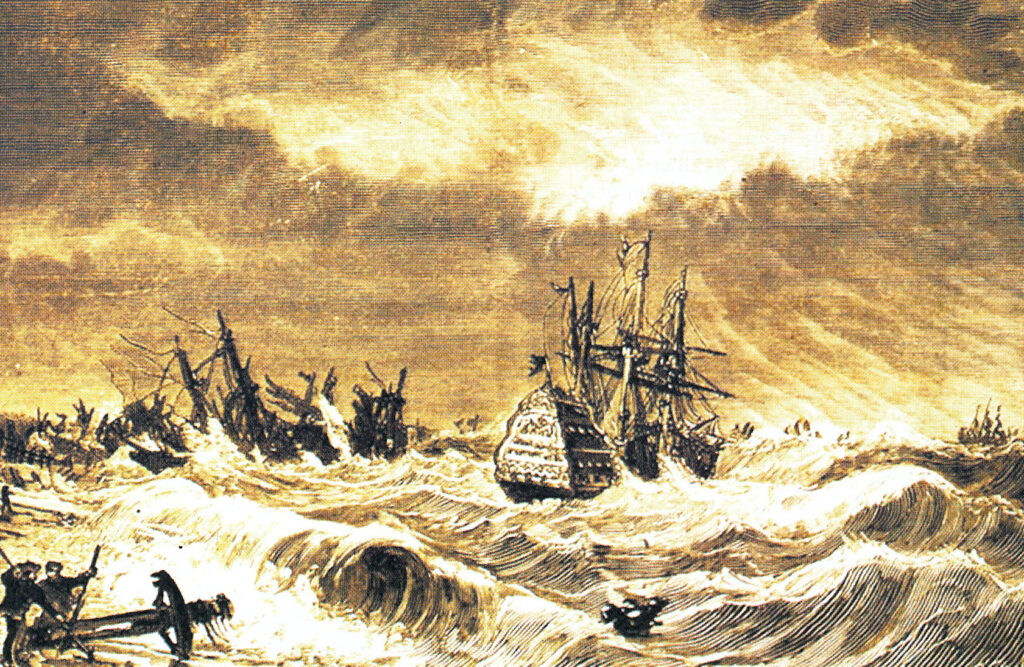
Sunk in the Great Storm of 1703 on the Goodwin Sands
What decision earned them then their terrible fate,
Near all who manned her on that fearful date
Officers, brave men and knaves
All helpless before the mighty wind and roiling waves?
Here were the mighty ships of the greatest British fleet
Fresh from a campaign in sunny Mediterranean heat
Ill prepared for the Channel’s icy winter gales
Soaked by seas and frozen by winds that shredded sails
The crew on deck saw the land and houses of Lower Deal
Their thoughts turned to women, ale, and a decent meal
But all came second to the watch’s worth
As Captain Johnson sought to find his ship a berth
In a crowded anchorage, it took all his skill to guide
His ship, under reduced sail and against the rising tide,
Between so many mighty naval vessels;
While, to reduce her canvas, the whole crew wrestles
They let go their best bower from the starboard bow
Ten fathoms of heavy hemp streamed from the prow
Then another twenty fathoms more
To keep the anchor holding on that sandy sea floor
Heavy canvas sails were lashed to the spars tight
Anchor watch set, the men stood down for the night
With salt beef, hard tack and stale beer …
And the anchor held whilst the gale winds blew clear
Stormy days followed but then a late November day
Saw a winter sun shine weakly as the waves lost their sway
Longshoremen and their beach boats were all around
And Admiral Sir Cloudsley Shovell was Medway bound!
His three-deckers up-anchored for a short sail worth
The safety and shore leave of a Chatham winter berth
The Stirling Castle watched them leave the sound:
They were for Portsmouth when the wind went round.
A short lull but in two days the south-westerly gales grew
Top-masts and lower yards were taken down by the crew –
To offer less purchase for the gale –
Lashed securely to the decks, but needed later when they sail
Late November: the new moon meant tides at high-water
Reached their strongest, with winds shrieking no quarter
Ships in the Downs dropped a second anchor fast,
As rigging and spars bowed before a wind that cracked a mast
Blocks and rigging fell among the men, spume crashed, flaying
The for’d watch as the anchor dragged, every man praying
At pumps to empty bilges, or in the maelstrom’s face
Watching for vessels dragging anchor, bearing down on their space
Hours passed, the wind blew stronger, the ebb tide began to flow
Against the wind: waves grew rougher, the anchor dragged slow,
Held, and dragged some more. Half turning to the tide
The ship rolled and mountainous waves took men over the side.
They knew she could not survive much longer. Men fell to prayer
Brave men, soaked, shivering, beaten by a mighty storm so rare.
At low tide they felt the keel judder on the Sands:
The Stirling Castle, broken on Bunt Head, sunk with her hands.
It was the early hours of the 27th November 1703
Of the four hundred men who set sail on the Stirling Castle
Only sixty-two survived the storm;
Over one thousand naval sailors were lost that night
But seventy ships rode out the storm.
After G M Hopkins: The Loss of the Eurydice
