______________________________ Please feel free to browse our website, ____________________________________ blog and the books in our shop! ______________________________________________
I think there is a need for some explanation of this poem. On May 28th a sudden thunderstorm blasted the life out of my router. My Internet Supplier offered a free new router with an upgrade to my service which gave me greater speed and capacity… but I had to wait until June 19th for installation. This didn’t seem too much of a problem as I was away for a week anyway. My appointment came and went without said installation and a period of many telephone calls, escalations of my case, and some frustration on my part went on until a new appointment on July 10th! It was surprising how cut off and incapacitated I felt! Writing became difficult! And so, on day 30, the poem…
In Vacuo
today communication is a shattered mirror in which my broken words are reflected:
today no imagined reader: confidant or voyeur can see through that smoky glass,
nor glimpse those small refracted shards of rhyme that I leave to sparkle behind my life
today the whisperers can no longer review my mind or muse at echoed hints of inspiration
today my world does not stretch beyond the trees my art is imprisoned by
Time is only memory, A previous life stretched, Calibrated in artifice, Checked by rusting chains. Dylan, who measured time — Time that let him play and be — In lamb-white days, Knew too well that time’s constraints Would hold him green and dying. We created our mythology of time To index our simple lives, but Time is life past and life to come And our petty measures Can only frame our misered view As we, heedless, dance ever forward Beneath the blue-framed sun And a myriad stars in a naked sky Which retain a myriad alien times.
“This head is more than churches or bibles or creeds” (Walt Whitman: Leaves of Grass) Hinduism: Ātman – The soul or the true or eternal self, or the self-existent essence within each individual.
My soul exists — it simply, is. So also my mind. The one perhaps deeper Buried than the other. We may say, I know my mind, My mind is made up As, consciously, we process the day, Accepting or denying the stimuli That the world and its people offer. But my soul is the me I have come to know In the years of my life. I can sit in silence and let my soul be While my mind worries the day. I know that my soul is the sum Of the me I know: The product of my upbringing, Of all my people and surroundings; It is the me that I know; That they know; The spirit at the core of me; The consciousness that I write: I am the poet of my soul.
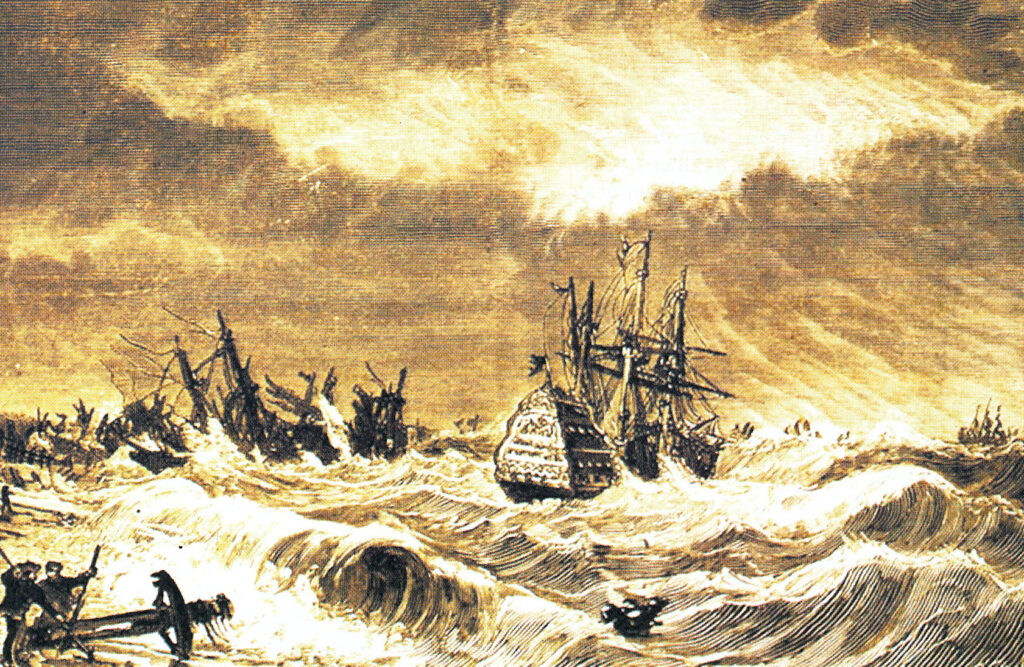
Sunk in the Great Storm of 1703 on the Goodwin Sands
What decision earned them then their terrible fate, Near all who manned her on that fearful date Officers, brave men and knaves All helpless before the mighty wind and roiling waves?
Here were the mighty ships of the greatest British fleet Fresh from a campaign in sunny Mediterranean heat Ill prepared for the Channel’s icy winter gales Soaked by seas and frozen by winds that shredded sails
The crew on deck saw the land and houses of Lower Deal Their thoughts turned to women, ale, and a decent meal But all came second to the watch’s worth As Captain Johnson sought to find his ship a berth
In a crowded anchorage, it took all his skill to guide His ship, under reduced sail and against the rising tide, Between so many mighty naval vessels; While, to reduce her canvas, the whole crew wrestles
They let go their best bower from the starboard bow Ten fathoms of heavy hemp streamed from the prow Then another twenty fathoms more To keep the anchor holding on that sandy sea floor
Heavy canvas sails were lashed to the spars tight Anchor watch set, the men stood down for the night With salt beef, hard tack and stale beer … And the anchor held whilst the gale winds blew clear
Stormy days followed but then a late November day Saw a winter sun shine weakly as the waves lost their sway Longshoremen and their beach boats were all around And Admiral Sir Cloudsley Shovell was Medway bound!
His three-deckers up-anchored for a short sail worth The safety and shore leave of a Chatham winter berth The Stirling Castle watched them leave the sound: They were for Portsmouth when the wind went round.
A short lull but in two days the south-westerly gales grew Top-masts and lower yards were taken down by the crew – To offer less purchase for the gale – Lashed securely to the decks, but needed later when they sail
Late November: the new moon meant tides at high-water Reached their strongest, with winds shrieking no quarter Ships in the Downs dropped a second anchor fast, As rigging and spars bowed before a wind that cracked a mast
Blocks and rigging fell among the men, spume crashed, flaying The for’d watch as the anchor dragged, every man praying At pumps to empty bilges, or in the maelstrom’s face Watching for vessels dragging anchor, bearing down on their space
Hours passed, the wind blew stronger, the ebb tide began to flow Against the wind: waves grew rougher, the anchor dragged slow, Held, and dragged some more. Half turning to the tide The ship rolled and mountainous waves took men over the side.
They knew she could not survive much longer. Men fell to prayer Brave men, soaked, shivering, beaten by a mighty storm so rare. At low tide they felt the keel judder on the Sands: The Stirling Castle, broken on Bunt Head, sunk with her hands.
It was the early hours of the 27th November 1703 Of the four hundred men who set sail on the Stirling Castle Only sixty-two survived the storm; Over one thousand naval sailors were lost that night But seventy ships rode out the storm.
A spot of yellow, of buttercup yellow, shone amongst the grazing grass and, cunning low beneath the sward, the ever mist-moist moss: yellow, risen to bring sunlight at end of dreary day
This is the pewter hour, dull dusk’s light loss drains energy from the fields, quiets the lambs to lie sheep-shielded, yet lets night’s beetle see, above the grounded grass, an outlived sun remembered
Around me, the unseen miracle Of the past: the birds in the tree—the hills—the clouds—the people passing by, I am at the centre of my time And they are all in the past What stranger miracles are there?
After Walt Whitman:
To me the sea is a continual miracle, The fishes that swim—the rocks—the motion of the waves—the ships with men in them, What stranger miracles are there?
To provide the best experiences, we use technologies like cookies to store and/or access device information. Consenting to these technologies will allow us to process data such as browsing behavior or unique IDs on this site. Not consenting or withdrawing consent, may adversely affect certain features and functions.
Functional
Always active
The technical storage or access is strictly necessary for the legitimate purpose of enabling the use of a specific service explicitly requested by the subscriber or user, or for the sole purpose of carrying out the transmission of a communication over an electronic communications network.
Preferences
The technical storage or access is necessary for the legitimate purpose of storing preferences that are not requested by the subscriber or user.
Statistics
The technical storage or access that is used exclusively for statistical purposes.The technical storage or access that is used exclusively for anonymous statistical purposes. Without a subpoena, voluntary compliance on the part of your Internet Service Provider, or additional records from a third party, information stored or retrieved for this purpose alone cannot usually be used to identify you.
Marketing
The technical storage or access is required to create user profiles to send advertising, or to track the user on a website or across several websites for similar marketing purposes.