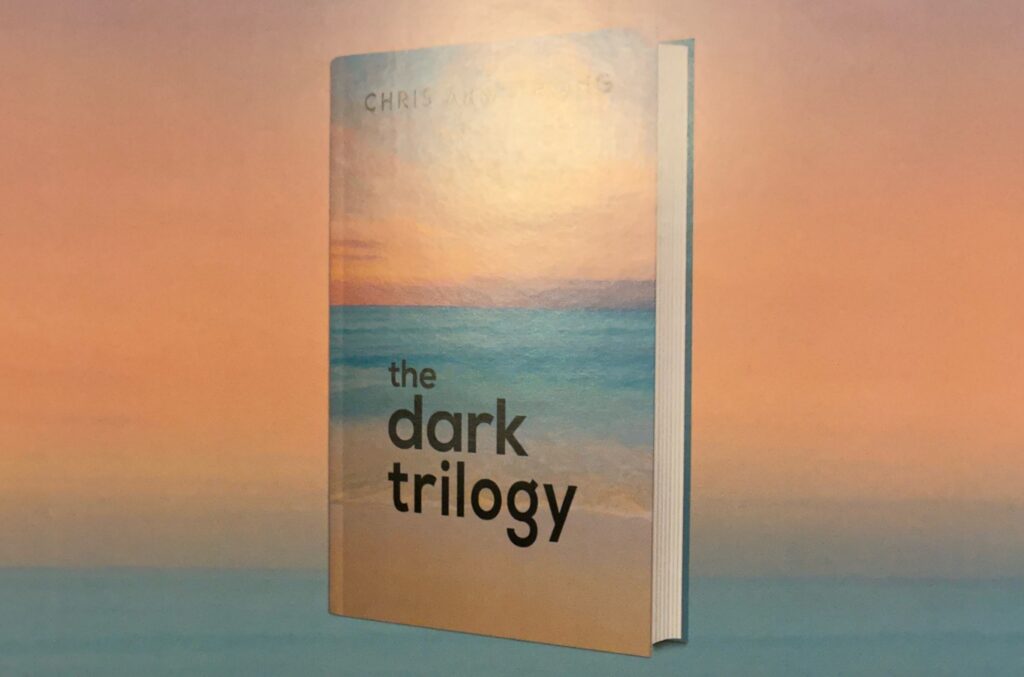
Tag: Chris Armstrong
Zen Reflexions
To discern
our place
To commune
To see
beyond our close shadow of death
To focus
my poet mind
I need direction
a qibla
Or some beads to tell
to take refuge from my life:
A candle flame
Only the candle
Flame
Flickering
A journey into quietude
begins
Into that silence
comes tranquillity
And the absence of words
Serenity beyond words:
I become sentient -
conscious of only this moment in the flame of a grain of sand
Of the sun shining through golden autumn trees
Of the clearing mists
dissolving in the valley and above the hills
giving way to rain that fills the sky
so that the branches droop, dripping
as the wind rustles the upper boughs
and drops spatter on the window glass.
Of love
Peace
Perhaps, now, I am no longer physical
But have become a spiritual being
having a human experience
Writing
And in the writing
the words return
Originally published in Mostly Welsh (Y Lolfa 2019, pp.51-52)
Notes
- Moliere: “Without knowledge life is no more than a shadow of death”
- qibla: Spiritual direction (the direction of Mecca)
- Zen Master, Hung Chih, writes of serene reflection in which one forgets all words and realizes – is aware only of – Essence.
- c.f. Blake: Auguries of Innocence: “To see a World in a Grain of Sand…”
- “We are not human beings having a spiritual experience, but…” Generally attributed to Pierre Teilhard de Chardin, SJ, a French idealist philosopher and Jesuit priest
Reality and Writing

Laurence Durrell once wrote, “Reality is too old-fashioned nowadays for the writer’s use. We must count upon art to revive it and bring it up to date” (Monsieur. The Avignon Quintet, 1974). Much of my writing – this is true of The Dark Trilogy and the poem at the heart of the novel, as well as of many of my other poems and, as you may discover when they are eventually published next year, also of many of my short stories – is based on (or around) my life.
Which may lead you to wonder if this is suggestive of a lack of imagination, or an unhealthy focus on myself (George Orwell noted that “Sheer egoism. Desire to seem clever, to be talked about” is one reason that people write. (George Orwell: ‘Why I Write’ Gangrel 4 (Summer 1946))… but I think perhaps it is just that writing for me – and perhaps for many others – is a cathartic exercise: such autobiographical writings simply offer their authors – if I may borrow Carlos Ruiz Zafon’s words – “the chance to look at themselves in the mirror of memory and for a moment believe they’ll live forever.” (The Labyrinth of the Spirit. 2018). I have to remember though that, more prosaically and perhaps rather more negatively, Evelyn Waugh wrote, “Only when one has lost all curiosity about the future has one reached the age to write an autobiography” (A Little Learning: An Autobiography (Vol.1), 1990). Jonathan Swift noted “there is in most people a reluctance and unwillingness to be forgotten… [and] if it be founded in our nature, as an incitement to virtue, it ought not to be ridiculed.” (Charles Peake quoted this in his 1971 essay, “The Coherence of Gulliver’s Travels.” In Claude Rawson (ed.) Swift. London: Sphere Books). But I hope at least that I remain curious about the future!
Meanwhile, like Durrell, I feel the need to revive my life, to embellish the boring facts and to bring them up to date! As Carlos Ruiz Zafon said “no genre is more fictitious than a biography”! Those who know me may recognise autobiographical fact amongst the fiction… perhaps, others will just read a fable!
An Unpublished Poem

There are about a dozen poems quoted in The Dark Trilogy that are not published in Mostly Welsh. Here is one of them!
The Interface
Books make visible the writer’s soul
Which bleeds its angst by pen:
Spread thin across life’s whited bowl
A thin red stain of madeleineBooks may offer us an author’s eye
That ensnares the reader within its brail
Or should writers light the reader’s sky
And tear apart the shadowy veil?Books will hold the writer’s thought
And bridge the gap twixt pen and readers
A mystic link so carefully wrought
To blazon unicorns among the cedarsThe writer’s flame burns bright with drama
With thanks to Proust, Baudelaire, Auden and di Lampedusa
As ashes from a tortured mind combust
For in the writing there must be karma:
Finding peace in a little heap of livid dust
The Scholar Critic

The device that I have used in The Dark Trilogy is one also used by Vladimir Nabokov in Pale Fire – that of using an imaginary second person – a scholar – to discuss and explain a poem, thereby narrating the story.
Nabokov’s Charles Kinbote wrote that his friend’s poem was a “sudden flourish of magic” and it will become evident that my scholar feels similarly about the poem of his friend. He too would of course suggest that his commentary should be read both first and during a reading of the poem as a reference and, like Kinbote, feels that the:
“… reality of its author and his surroundings, attachments and so forth, [is] a reality that only my notes can provide. “
The literary persona of my scholar-critic – a friend of the poet since their school days – is unduly proud of his scholarship and of his writing skills. He is also very much in the habit of writing scholarly papers, so his introduction, his commentary on the poem and even his biographical notes are peppered with footnotes which serve to demonstrate his own knowledge and skill as much as they help the reader! He also, with some justification, feels that he should be the one to write at length and in some depth about his friend.
Perhaps you will feel that the scholar is writing as much to serve and promote his own aims – a major publication, association with a great poet, evidence of his research skills, and so on – as to respond to the poet’s request:
… You must know that my health is failing and that these days I rarely leave my home on the South Downs, valuing the peace of the rolling countryside and the view of the distant sea above companionship and travel; so when my publishers asked me to work on a new version of ‘Retrospective’ my first thought was to refuse. That was until I re-read the poem and was once again transported back to my early lives and loves. I DO believe that the poem deserves another outing! And what I believe would enhance its brevity are the stories behind it, but I have no longer the energy. I should like to see a commentary to the poem which opens up the histories which underpin my lines. Christo, having known me for most of my life I know that you will be able to unravel the often difficult themes and thinking lying behind the lines of the work I am now calling ‘Dark Ashes’ …
Or perhaps you will see a colleague determined to bring his good friend’s poem to the wider audience it deserves.

So said Carlos Ruiz Zafon – it is the lead quotation at the beginning of Book I. In an interview recently published in Poetry Wales, the poet Tim Relf says: “I don’t believe any of us are reliable narrators of events, even to ourselves. My latest collection Same Difference returns to that idea in various forms: how our life is what the novelist Julian Barnes refers to as ‘the story we have told ourselves’.”
I have tried, in The Dark Trilogy, to blend the story that I have told myself about myself, about my life, with an older history that might have been mine. Once. I have dived into the depths of one of my poems and surfaced with far more than I had dreamt was in the lines. ‘Retrospective’ – the poem in Mostly Welsh (Y Lolfa, 2019) that became ‘Dark Ashes’ – was avowedly autobiographical of a part of my life but I never wrote a second, older, life into those lines. Or so I thought! In taking on the role of my own editor and critic in Books I and III of The Trilogy, I allowed the possibility of there being more behind the 326 lines of the poem than I had been conscious of. A second story. A second – older – life. So there are two biographies in Book I. And at least one of them – the one to which Book II adds – is true.
But memory is a curious thing! As some past event is recounted for the first time a small fact – the colour of a dress or the positioning of a piece of furniture in a grandparent’s house – might be added, perhaps hesitantly, doubtingly, in error… but in the very act of speaking about the event that erroneous image is cemented into the memory – fixed to the extent that on subsequent retellings the blue dress is there, in the picture, as your mother stood in front of her parent’s sideboard. And now there is no question in your mind that you are describing things as they really were! An autobiography is the curated sum of our imagined memories.
In The Lady in the Van, Alan Bennett wrote “You don’t put yourself into what you write; you find yourself there.”
The Dark Trilogy: Agon
So, a beginning. The agon, that conflict of my personae, that conflict of my characters. Today the wind has been blowing from the west and the rain, which has kept me from the little garden surrounding my cottage for the past week, continues on and off: then it was sunny… As I drove slowly along the country roads towards home, through the leafy shades, between the high hedges and patches of sunlight, past hamlets and villages, my mind ran back to the many times I had passed this way before. Times almost half a century ago when …
Enough said!

Can’t really fault their advice so I thought I would pass it on!
In The Dark Trilogy, Trystan Lewis the poet, my fictional alter ego, has his work and his life examined through the critical lens of his scholarly friend and editor. Trystan’s scholarly childhood – lifelong – friend knows him so well! So well that in explaining the poem at the heart of the story he puts Trystan’s life and his writing under a microscope! As only he could! And he finds that there is so much to tell… as you will discover in the partly fictional autobiography that makes up the first book of the Trilogy. And in analysing the poem and setting it amongst other poems by the poet – many of which, including some unpublished works, are quoted in the book – the scholar also finds a hidden story, one that the poet did not realise he had told. So the book holds two life stories displaced by several hundred years, histories which interweave and come together in the Welsh mountains in the present day.
Innocent
he met a force
Untried
it held him
… and wonder drained the world of substance
re-arranged the pages of his book to give more radiant
a reading…
It is about a life: the poet’s life, my life… and as The Dark Trilogy would have it, my lives.